Wednesday, May 4, 2016

Your Brain Map

1.   What do the frontal lobes do?
The frontal lob controls the personality, problem solving, memory, language, judgment, and impulse control.

2. What is the relationship between selective attention and learning?

      Selective attention allows you to increase memory and allows you to select what is important. When learning, you select what is important to remember and how to use it.

      3. What is the last part of your brain to develop and what can you do to prevent it from deteriorating?
       The frontal is the last part to develop and you can prevent deterioration by being more active and connecting ideas that you learn to bigger ideas. 
     4. What does the neo cortex do?

      It helps guide you by controlling motor skills.

      5.  What is the role of the pre frontal cortex?
      It controls your personality and how you act in social situations.

      6. What do we know about the pre frontal cortex’s relationship with multitasking?
      It helps manage what is important and prioritizes one action over another. 

      7.      Which part of the brain is associated with speech and language development?  Give an interesting fact about this region.
      The Broca's area helps with speech development. A person is still able to produce speech even when this area is damaged as functions shift to other parts.

      8.      Which part of your brain is responsible for thinking the following: “Is it hot in here or is it just me?”
      The Somatosensory cortex helps sense if the temperature is too cold or hot.

9. What does your visual cortex do for you?
   It helps differentiate color and identifies faces.

      10. State three interesting or significant facts about your occipital lobe.
      It is the visual processing part of your brain. It allows you process long term and short term memories. You can exercise this part by using your imagination. 

      11. What would happen if your temporal lobes were damaged?
      You will have trouble recalling things from memory. 

      12.    What is your “fast brain” and what does it do?
      The fast brain is the motor cortex and helps control the senses
      
      13. State 3 things that you could do that would influence your synapses, and have a positive affect on your life and health.
      You can exercise and have a healthy diet as well as becoming an active learner

      14.What is the relationship between multi-sensory or multi-modal learning and your dendrites?
      Multiple types of stimulation will help you learn things faster by engaging multiple parts of your brain

      15.How does “big picture thinking” and mnemonics affect dendrites and/or learning?
      It helps by connecting ideas together and using your brain in different ways b actively learning


      16. Describe a neurotransmitter that you feel is very important.  Justify your reasoning.
      I feel that dopamine is an important neurotransmitter because it helps you become motivated to do things and learn things.


             17.What does the corpus callosum do?
       it connects the two hemispheres. It controls oral skills and language and deals with handwriting as well as the movement of the eyes.


      18. What is the relationship between music and the corpus callosum?
      The corpus collosum is strengthened through music as it strengthens communication between the two brains

      19.Why is the thalamus important?
      The thalamus controls motor control and sensory imformation.

      Relate and Review
      In this activity I learned about the different parts of the brain. The simulation showed the relative areas that the parts covered and how they all fit together. The frontal lobe covered a large portion of the brain and it was interesting to learn how to keep the frontal lobe healthy with active learning. The neo cortex is a part of the brain that controls motor functions. The different neurotransmitters were also interesting to learn about and how each affected the brain and their function in everyday life. Healthy diets and exercise also help with dendrite health. The corpus collosum connects the two hemispheres of the brain and actually serves to help understand language and can be strengthened by practicing music. 


Monday, May 2, 2016

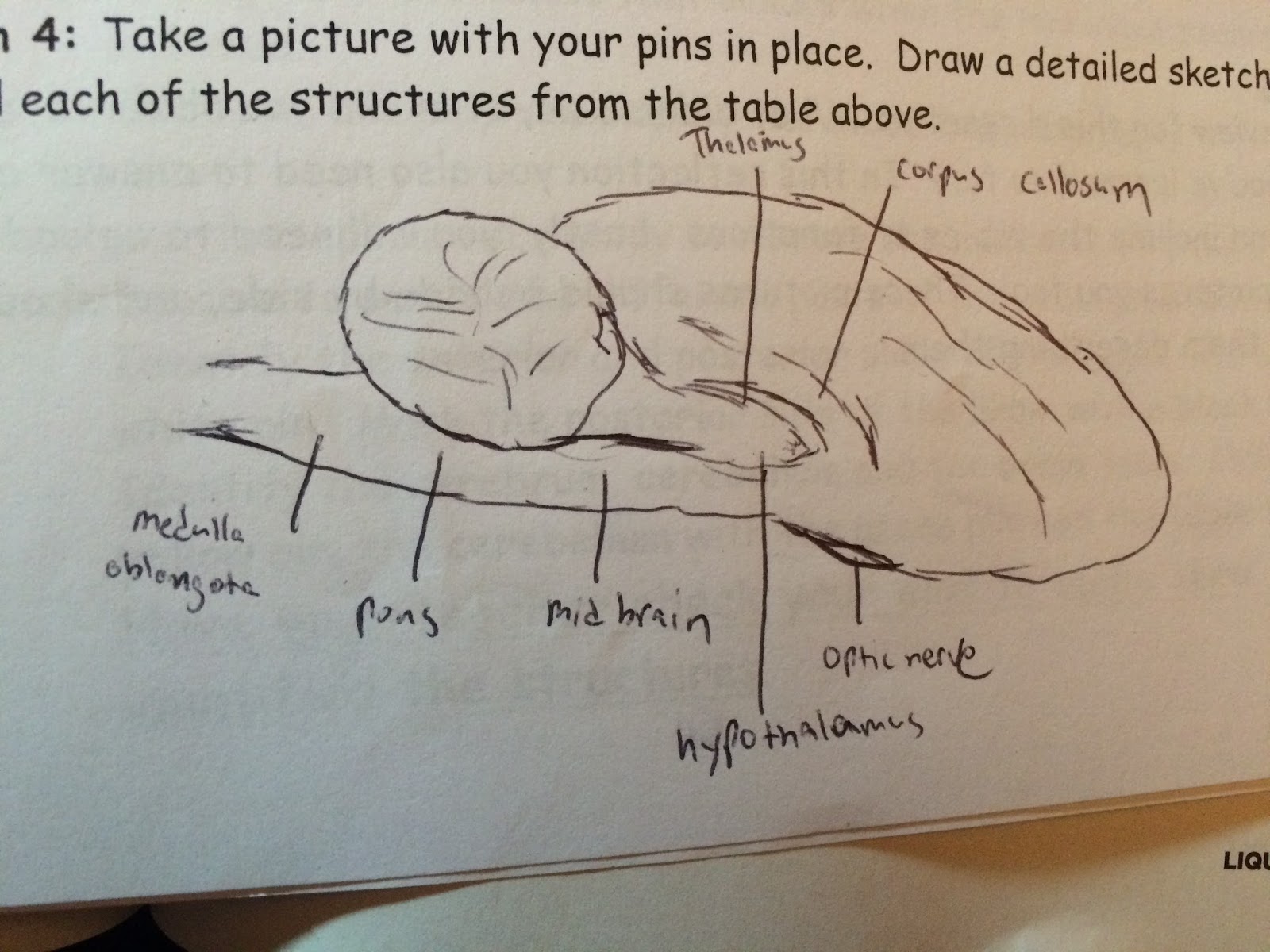
Brain Dissection


1. 


2. Brain stem- regulates automatic systems such as heart beat and breathing
    Cerebellum- coordinates voluntary movement
    Cerebrum- divided into four lobes and controls thought and action
    Posterior- back part of the brain
    Anterior- front part of the brain


3. Myelin helps impulses move across neurons faster 

4.


5. Thalamus- controls information between  cerebral cortex and lower brain helping with sesnory interpretation 
     Corpus Callosum- bridge between two hemispheres
     Medulla Oblangota- controls heartbeat and breathing
     Pons- controls information between cerebrum and cerebellum
     Mid Brain- controls vision and hearing 
     Hypothalamus- helps control the endocrine system and hormone levels
     Optic Nerve- transfers information from optic nerve to brain
     

6.


Relate and Review
In this lab we opened up a sheep brain and located the different parts of the brain. In this unit we learned about the parts of the brain  ,and their functions. With the help of the clay model we did, this lab helped give us a better visual representation of what those parts look like ,and how they all fit together. This dissection helped us understand the shape and functions of each of the parts as well as gave us hands on experience. 


Thursday, April 28, 2016

Sheep Eye Dissection Analysis

The lens of the eye is used to focus on objects at various distances. Some of the vitreous humor is surrounding the lens. The vitreous humor helps refract light.

. 
The opening is the pupil and the surrounding brownish layer is the iris. The pupil controls how much light enters the eye and the iris controls how big the pupil is The black layer is the ciliary body which helps stretch the lens in order to focus better on different objects. 


The transparent part is the cornea and the surrounding grey part is the sclera. The cornea allows light into the eye and helps with refraction and the sclera helps keep the shape of the eye ball.

The retina is the clear and thin gel layer and helps processes the image from the lens. The bluish and greenish part is the choroid. This part of the eye provides nourishment.


Thursday, April 14, 2016

The Clay Brain


In this activity we modeled the left hemisphere at the sagittal plane and the right cerebral hemisphere at the lateral view. The different parts are labeled and different colors were used to show the relative size and area of the part. 

The Woman with a hole in her brain

A woman had trouble walking and felt nauseous. When she entered a hospital, it was discovered that she was missing cerebellum. The cerebellum controls voluntary movement as well as balance. It made sense that the woman felt these symptoms throughout her life, but it was miraculous that how minor they were. Her case shows how the brain how the brain can adapt and compensate for missing functions.

If the brain's Brocca's area is responsible for language and speech production. If someone were missing this area, they would not be able to produce speech. They could still survive without it and still be able to understand speech. The Wernicke's area can partially compensate by helping the person understand and process speech.

Thursday, March 24, 2016

Unit 7 Reflection

In this unit we learned about the different movements of the body and specific vocabulary to describe them. These movements happen at synovial joints. There are angular movements such as flexion and extension and special movements such as elevation and depression. We also learned about how muscles are organized and classified. Muscles are in charge of the movements of bones or fluids and help maintain posture and body posture. They have certain properties that help them with these functions i.e. contractility, extensibility, and elasticity. There are many terms that classify the size, shape, number of origins, and location of the muscles. These are used to identify specific types of muscles. To deepen our understanding we dissected a chicken carcass and identified the different muscles and tendons while relating them to human muscles. In this unit we also discussed how how muscles contract and how an impulse translates though to movement that is driven by the release of calcium and ATP. To illustrate this process, we made a muscle contraction video. To end the unit we went over how muscles develop ,and how specific types of exercises can help muscle health and growth. Muscles have slow twitch and fast twitch fibers. Long duration uses slow twitch while shorter duration exercises use fast twitch. Exercises such as weight lifting can benefit muscles while certain shortcuts can actually cause more harm such as steroids as shown by our satirical advertisement.
Chicken dissection 
Advertisement that shows how the benefits of steroids do not outweigh the health problems that come with it

I enjoyed the different activities and labs in this unit because they helped simplify the complex system of muscles and how they worked. This unit made me more curious about how muscles develop ,and I want to learn more about how muscles are able to carry such large amounts of weight.

My New Year's goals are still in progress and I am currently doing well in staying more organized and being healthy. I feel that my lifestyle has changed ,and I am still working to make it better.


Wednesday, March 23, 2016

Performance Enhancements Advertisement


Steroids seem to appeal to people because they think that whatever they are currently doing is not enough for them to get the ideal body or meet their own standards. Anabolic steroids may increase muscle gain, but its costs are not worth it. It can cause an increase in blood pressure, heart disease, liver damage, stroke, and many other health problems. It can also affect gender specific qualities such as sperm count and breast size. Steroids are definitely not a safe performance enhancement.  
Other enhancements such as high protein diets (if paired with the proper amount of exercise and done properly) and strength training are safe ways to increase performance and gain muscle. They might require more time the other ways, but have little to no risk if done properly as apposed to steroids and androstenedione which can cause an imbalance in hormones.